
The Laser Ceiling
Why Indium Phosphide, Not Silicon, Might Be AI’s Tightest Chokepoint

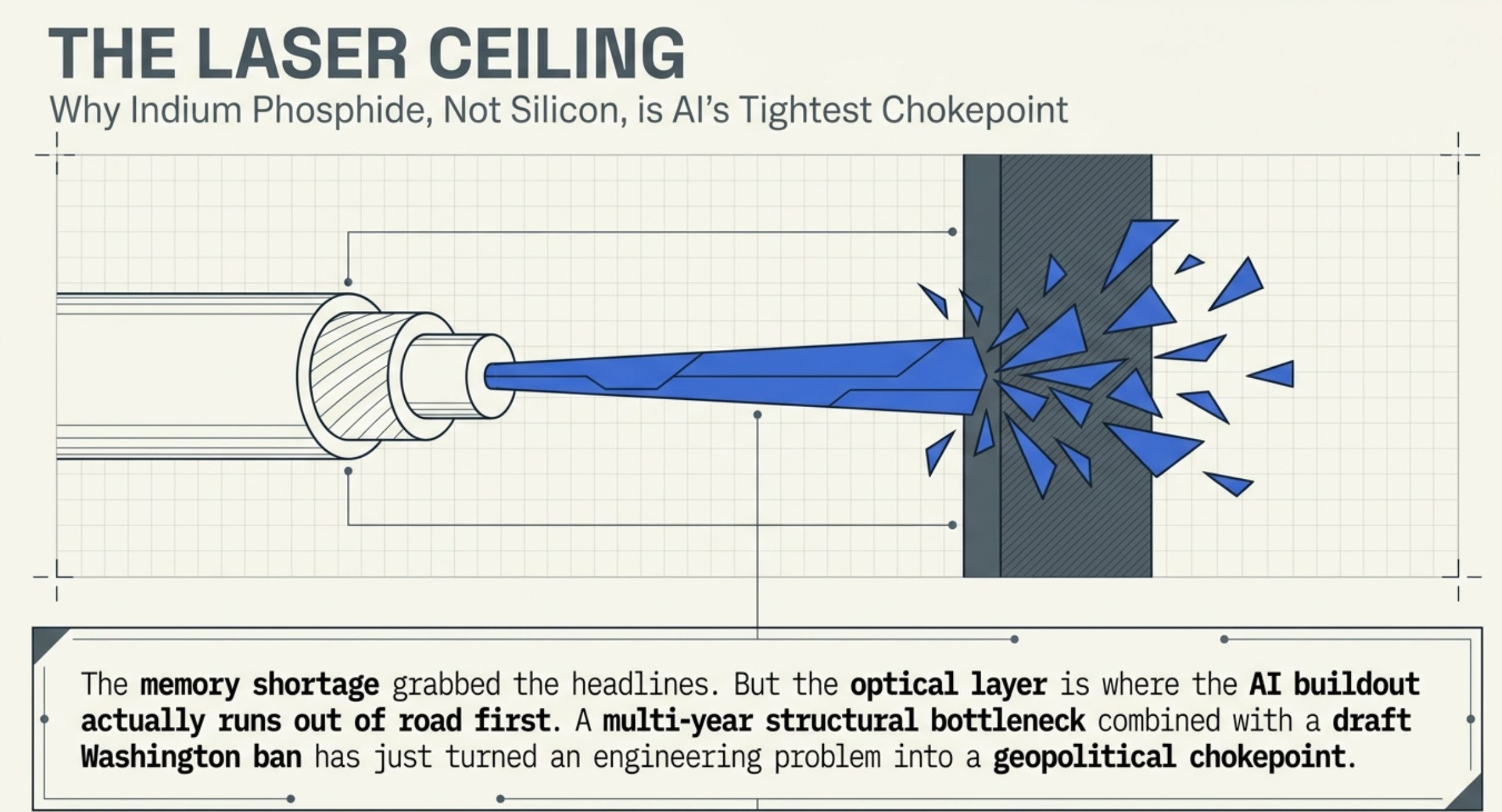
The memory shortage got the headlines. The optical layer is where the AI buildout actually runs out of road first — and a draft Washington ban just turned a supply problem into a geopolitical one.
On July 8th, in a conference room in Paris, Lumentum CEO Michael Hurlston said the quiet part out loud at the RAISE Summit: the compound semiconductor propping up the nervous system of every AI data center is now scarcer, relative to demand, than DRAM. Not a little scarcer — Hurlston put the gap between what Lumentum can ship and what customers want at more than 30%, a number that has widened, not narrowed, even as the company doubled its laser chip shipments year over year. Five indium phosphide (InP) fabs, and Lumentum still can’t keep up.
Three weeks later, Digitimes reported that Samsung, SK Hynix, and Micron had already sold out their entire 2027 DRAM and HBM production capacity — before most of the industry had finished its summer allocation calls. And four days after that, Reuters broke the story that the Trump administration is drafting a Federal Communications Commission rule to ban imports of new Chinese optical transceivers, the modules that let data travel between racks of GPUs at the speed of light.
Three headlines, one thesis: the AI buildout is no longer bottlenecked by GPUs. It’s bottlenecked by the physical stuff that gets data to the GPUs and the memory that feeds them — and in the optical layer specifically, the shortage is structurally worse than memory’s, the fix takes years even in the best case, and Washington just proposed handing the entire non-Chinese supply base a captive market. That’s the setup. Here’s the thesis in one sentence: the market is still pricing indium phosphide optics as a cyclical component story when it’s actually a multi-year structural bottleneck with a geopolitical tailwind bolted on — and the chokepoint sits in a smaller, stranger set of hands than most investors have priced in.
Why does the timing matter right now, this month, rather than six months ago or six months from now? Because three catalysts are converging inside a single earnings season. Lumentum reports fiscal Q4 on August 11th. Coherent reports fiscal Q4 on August 12th. And the FCC’s draft transceiver ban — which triggered a rally across every non-Chinese optics name the day it broke — is still just a draft, meaning the next few months of rulemaking noise will move these stocks more than the underlying demand curve will. If you want to understand where AI capex actually goes to die on the workbench, and who gets paid regardless, this is the layer to know.
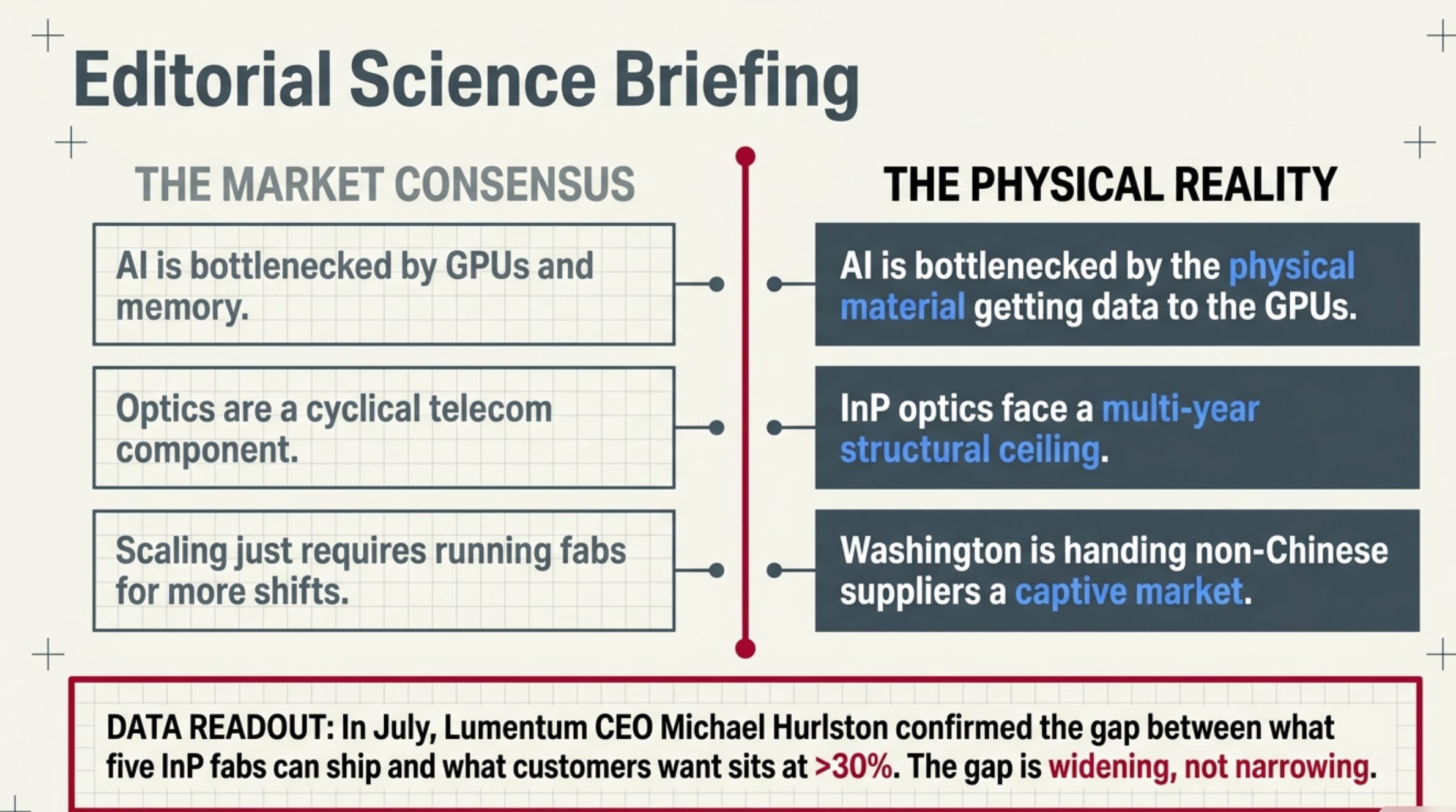
Table of Contents
The Market Opportunity
The Core Technology — Why Light Is Harder Than It Looks
The Key Bottleneck — A Structural Gap, Not a Cyclical One
The Players Racing to Solve It
The Economics of the Solution
7 Powers Moat Breakdown
The Fallback Scenario
Risks to the Thesis
Conclusion — Who Owns the Chokepoint
1. The Market Opportunity
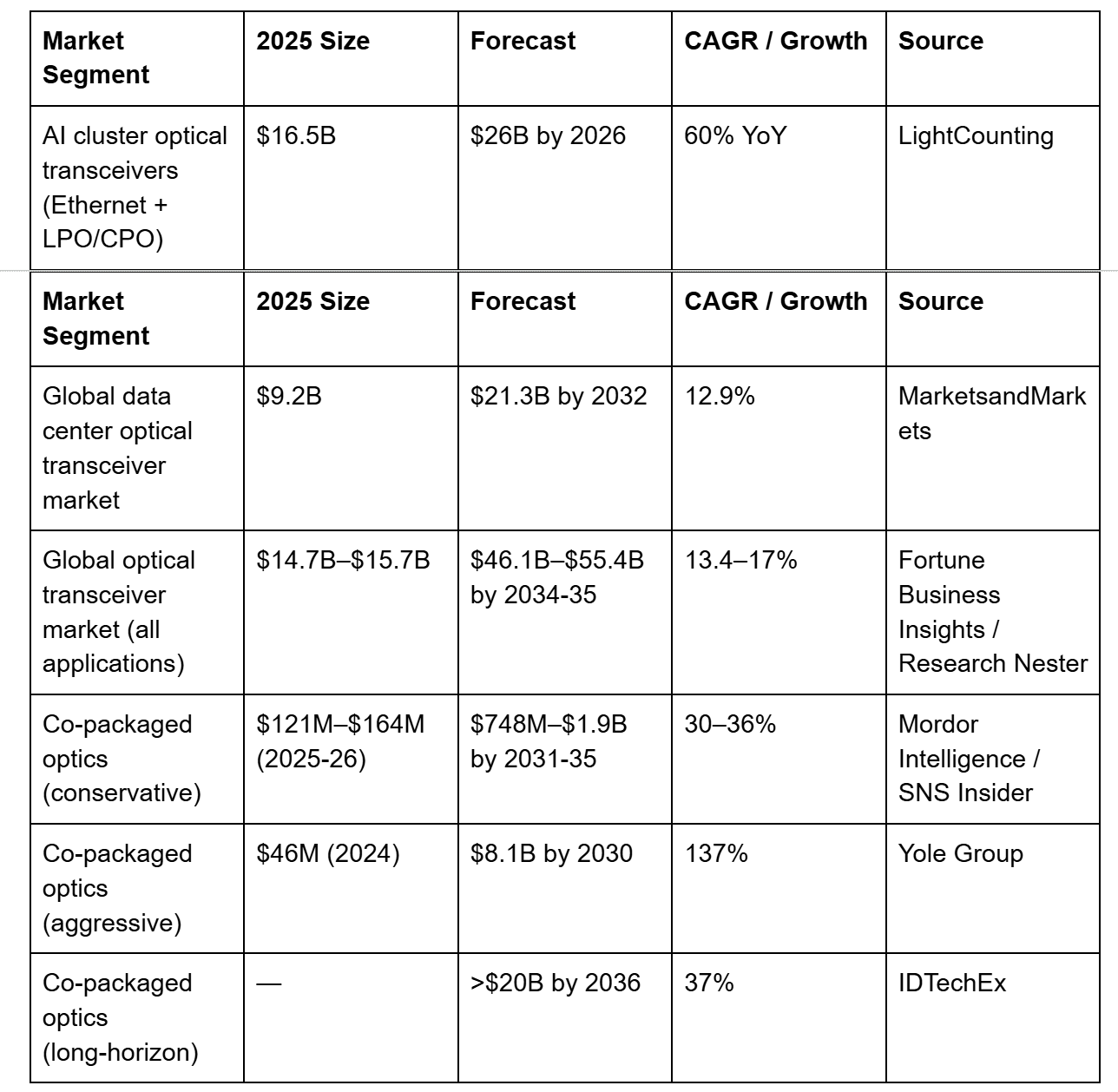
Start with the number nobody agrees on, because the disagreement is itself informative. Depending on which research house you ask, the optical transceiver market is either a $9 billion, a $15 billion, or a $16.5 billion business in 2025 — and depending on how narrowly or broadly they define “AI optics,” it’s projected to be worth anywhere from $21 billion to $55 billion by the early-to-mid 2030s, or as much as $100 billion by 2030 in LightCounting’s bull case for AI cluster optics alone. That’s not sloppy research. It’s a market whose boundaries are still being drawn in real time, because the product categories driving it — 800G and 1.6T pluggables, linear-drive optics, co-packaged optics — barely existed at scale two years ago.
The figures that matter most for this piece come from LightCounting, which tracks the Ethernet optics segment feeding AI clusters specifically: roughly $5 billion in 2024, $16.5 billion in 2025, and a forecast $26 billion in 2026 — 60% growth two years running. The firm’s April 2026 update trimmed its 2026 growth forecast from 82% to 65%, and it was explicit about why: not softening demand, but a hard production ceiling on InP laser chips.
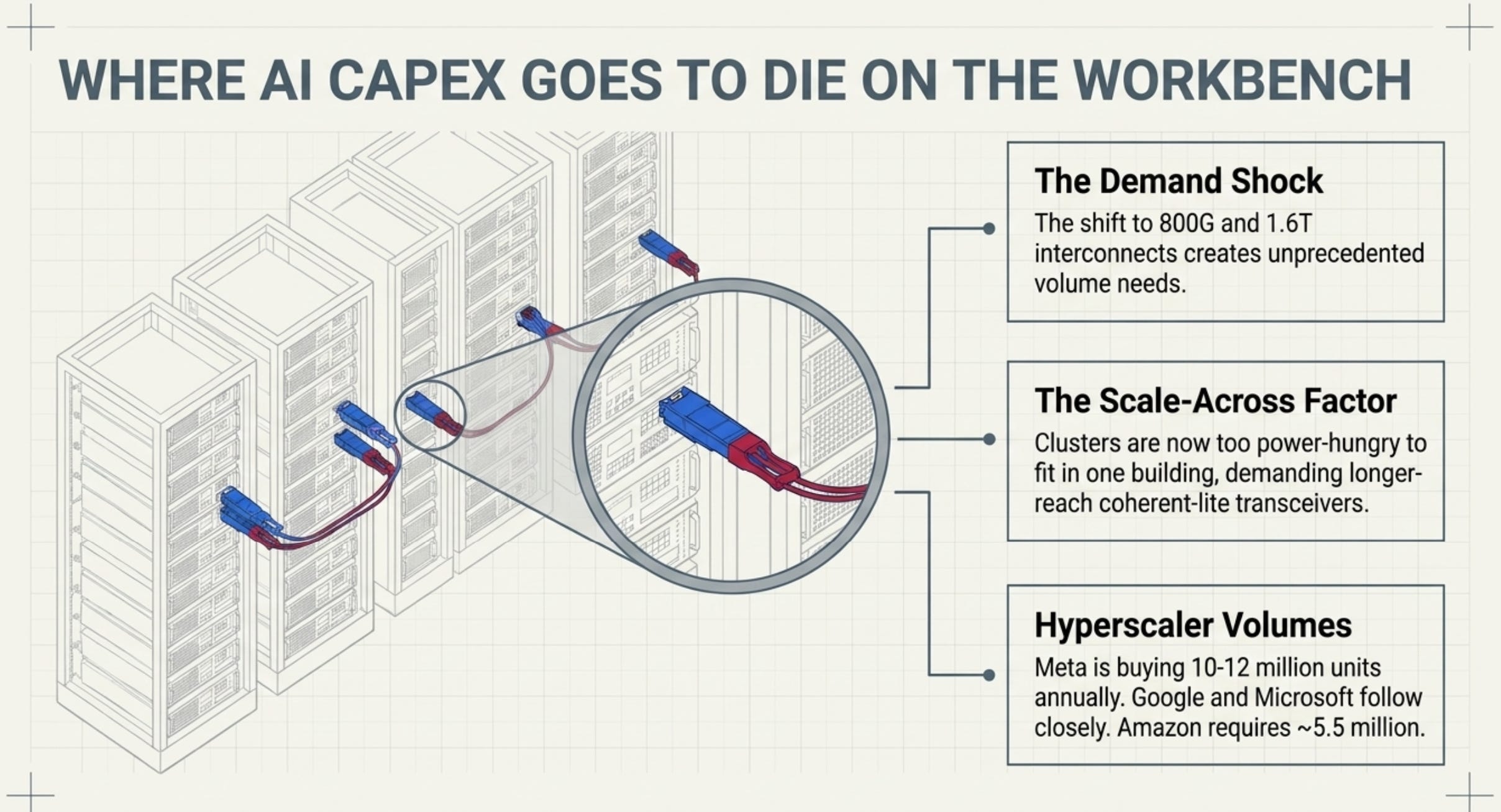
The demand drivers are the ones you already know if you’ve followed the AI capex story: the shift from 400G to 800G to 1.6T interconnects inside GPU clusters, the move from copper to optical for anything beyond a rack or two, and — the newer wrinkle — the emergence of “scale-across” AI clusters that are physically too large and too power-hungry to fit in one building, which creates an entirely new demand pool for longer-reach coherent-lite transceivers that didn’t really exist as a category eighteen months ago. Meta alone is reportedly buying in the range of 10–12 million transceiver units annually; combined, Google and Microsoft are in a similar range; Amazon around 5.5 million.
The point of laying out five different market-size estimates side by side isn’t to pick a winner. It’s to make the case that this is a market still being sized by people scrambling to catch up with actual shipment data — which is exactly the environment in which a supply bottleneck becomes an investable asymmetry rather than a well-understood risk already baked into consensus numbers.
2. The Core Technology — Why Light Is Harder Than It Looks
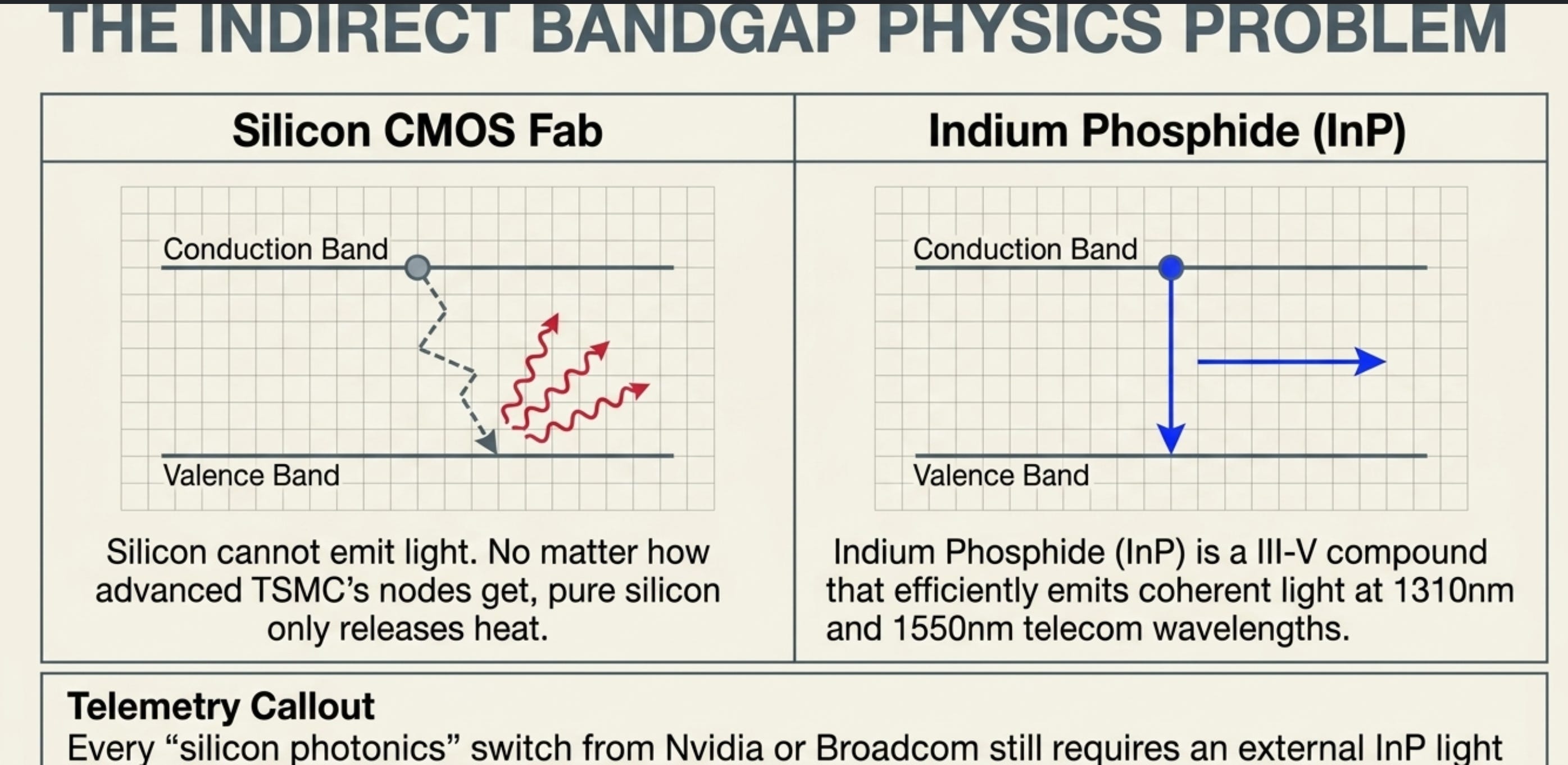
Here’s the physics problem nobody in the AI trade wants to think about, because it’s inconvenient: silicon cannot emit light. Its indirect bandgap means electrons recombine without producing usable photons, so no matter how good TSMC’s process node gets, you cannot build a laser out of pure silicon. Every silicon photonics platform — including the “silicon photonics” switches Nvidia and Broadcom are shipping — still needs an external, compound-semiconductor light source bolted on. That’s where indium phosphide comes in: a III-V compound semiconductor whose direct bandgap lets it emit coherent light efficiently at the telecom wavelengths (1310nm and 1550nm) that fiber optics are built around.
Two device types matter most for this story. The EML (electro-absorption modulated laser) integrates a distributed feedback (DFB) laser section — which emits the light — with an electro-absorption modulator section — which imprints the data onto it — on a single InP chip. It’s the workhorse component inside 800G and 1.6T pluggable transceivers, and it’s genuinely hard to make: two different functional structures grown epitaxially on the same die, with tight tolerances on both. The CW DFB laser (continuous-wave, no integrated modulator) is structurally simpler, and it’s the component of choice for co-packaged optics and silicon photonics architectures, where a separate silicon chip handles the modulation and the InP laser’s only job is to supply a stable beam of light — often from outside the package entirely, as an “external light source” (ELS).
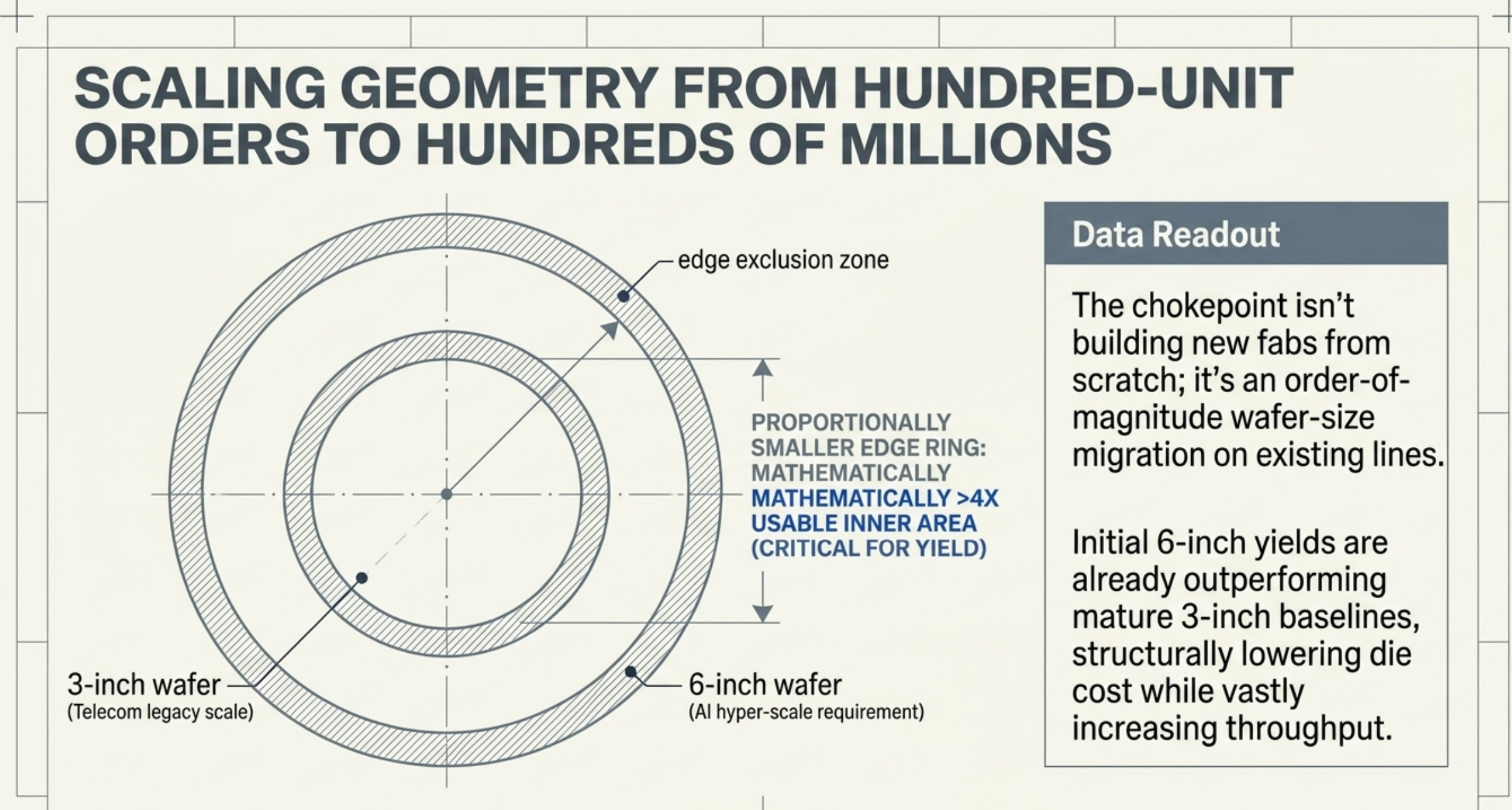
The reason this is a harder manufacturing problem than it looks is wafer geometry. Silicon CMOS fabs run on 12-inch (300mm) wafers, a scale advantage refined over five decades. InP epitaxy, by contrast, has spent most of its commercial life on 2-inch to 4-inch wafers — telecom-scale production for telecom-scale demand, where a major customer order was measured in the hundreds of units. Hurlston’s framing of the demand shift is the cleanest way to see the problem: telecom customers used to buy lasers by the hundred. Nvidia and the hyperscalers are now asking for volumes in the hundreds of millions. That’s not a linear scale-up problem you solve by running the existing line for more shifts. It’s an order-of-magnitude wafer-geometry problem, and the industry is mid-transition — from 3-inch to 6-inch InP — right now, in real time, with customers watching the yield curves in earnings calls.
3. The Key Bottleneck — A Structural Gap, Not a Cyclical One
The headline number is the 30%+ supply-demand gap that Hurlston has now cited twice — first on Lumentum’s May earnings call, again in Paris in July — and that LightCounting independently corroborated in its April 2026 forecast. What makes this more than a talking point is that the gap has been widening even as absolute output rises. Lumentum shipped twice as many laser chips in its fiscal Q3 as a year earlier and still couldn’t clear its backlog; 200G EML revenue doubled sequentially and the shortfall didn’t budge. That’s the signature of genuine structural scarcity, not a temporary logistics snarl: supply and demand are both growing, but demand is compounding faster off a much larger new base.
There’s also a bottleneck-within-the-bottleneck that caught even Lumentum off guard. On the same call where management reaffirmed the EML shortfall, Hurlston noted that pump laser supply — the III-V lasers used in erbium-doped fiber amplifiers for long-haul and subsea links, materially different chemistry from EML — was constrained more severely than EML, and that this had emerged as an unanticipated pressure point layered on top of the AI-driven demand story. In other words: the industry solved for one shortage and found a second one hiding behind it.
The reason this doesn’t resolve on a normal semiconductor timeline is worth sitting with. In most chip shortages, the fix is “build more fab capacity,” which takes two to three years and a lot of capital, but it’s at least a known playbook. The InP shortage is different in a genuinely interesting way: the fix isn’t new fabs from scratch — it’s a wafer-size migration on existing production lines, from 3-inch to 6-inch, where early yields are already coming in ahead of the old smaller-wafer baseline. That’s the bull case for a faster-than-typical resolution. Coherent, for instance, said its 6-inch InP ramp is running at roughly 80% of its target wafer-start rate for a full doubling of internal capacity, ahead of its original schedule. LightCounting’s own view is that the shortage should meaningfully ease by the end of 2026 — a call worth flagging now, because it’s the single biggest variable standing between this thesis and a much shorter shelf life than the framing above implies. More on that in the risks section.
Layer the memory story on top and the picture sharpens. Digitimes’ report that Samsung, SK Hynix, and Micron have sold their entire 2027 DRAM and HBM capacity — leaving customers with only 60–70% of the volumes they originally requested, and pushing PC and smartphone allocations down hard in favor of cloud and AI customers — isn’t a separate story from the optics shortage. It’s the same story told in a different material. AI capex is now large enough, and compounding fast enough, that it’s running into physical capacity ceilings simultaneously across at least two unrelated compound-material supply chains that took decades to build at their current scale. That’s not a one-off shortage. That’s what a structural hardware supercycle looks like from the inside.
4. The Players Racing to Solve It
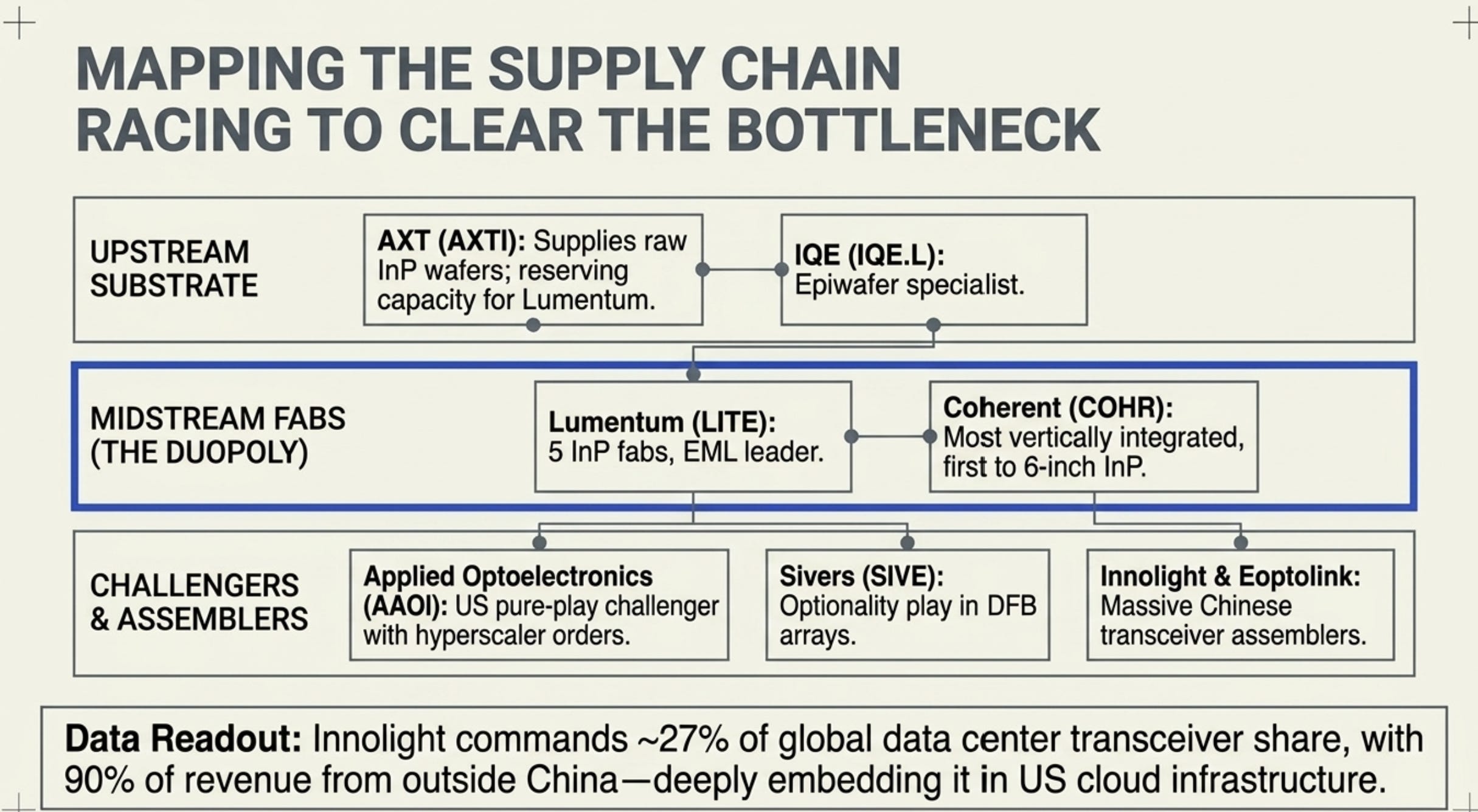
The competitive map splits cleanly into three tiers: the two large-cap vertically integrated incumbents that Nvidia has explicitly bet on, a set of smaller pure-play challengers racing to grab share while the incumbents are capacity-constrained, and an upstream substrate layer that almost nobody outside the industry pays attention to — but arguably matters more than any of the household names.
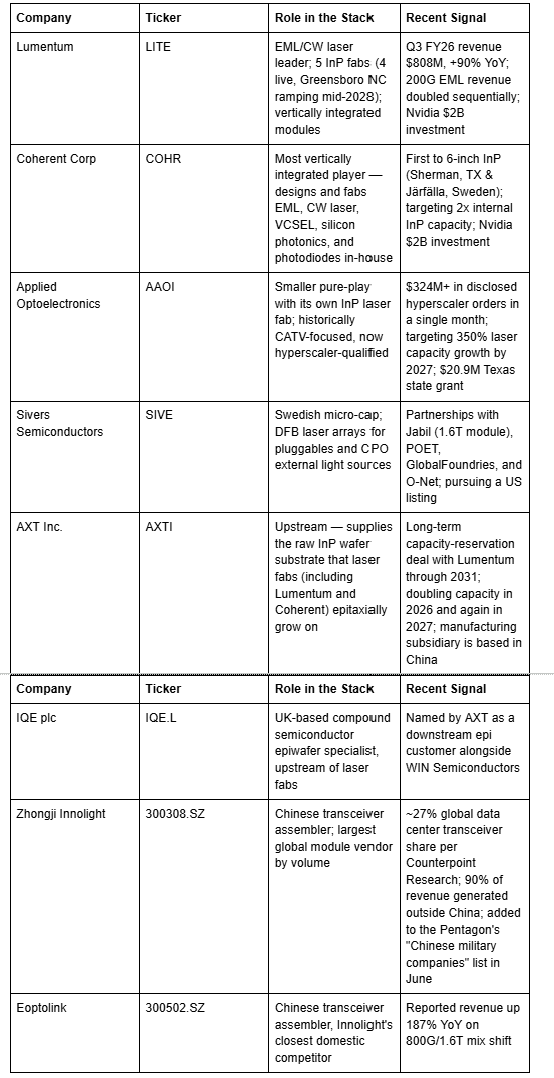
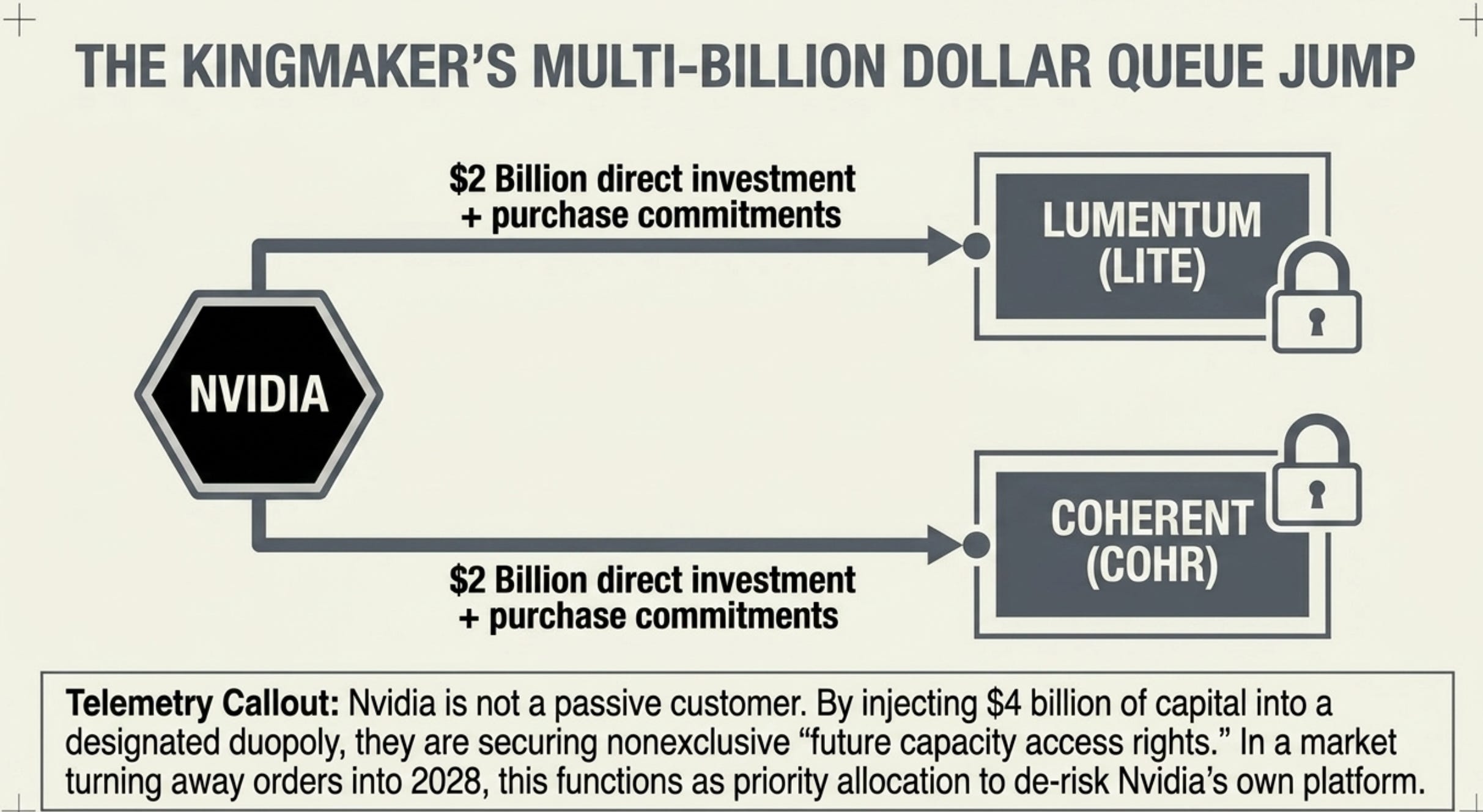
Two things stand out. First, Nvidia isn’t playing this as a passive customer — it’s put $2 billion of direct investment into each of Lumentum and Coherent, on top of multibillion-dollar purchase commitments and future capacity access rights, explicitly to de-risk its own optical supply chain and steer Lumentum toward building a new US fab. That’s $4 billion of capital deliberately concentrated into a two-company duopoly, which tells you where Nvidia thinks the real chokepoint sits — not in GPU compute, which it controls, but in the optical layer, which it doesn’t.
Second, the Chinese side of the ledger is bigger than most Western investors give it credit for. Innolight’s 27% global share, cited in the Foundation for American Innovation report that underpins the Reuters ban story, makes it larger than Lumentum and Coherent’s transceiver businesses combined by unit volume — and 90% of that revenue already comes from outside China, meaning the FCC’s proposed restriction would hit a company that is, commercially, deeply embedded in the exact US cloud infrastructure the rule is meant to protect. That’s precisely why the ban is a genuine catalyst rather than a formality: AWS, Coherent, and Lumentum all declined to comment when Reuters asked, and networking stocks broadly rallied the day the story broke — the market reading it correctly as a demand-reallocation event, not a security footnote.
5. The Economics of the Solution
The economics of solving this bottleneck run through wafer geometry, and the math is more favorable than it first appears. Moving from a 3-inch to a 6-inch wafer doesn’t just double the diameter — usable die area scales with the square of the radius, so a 6-inch wafer carries roughly four times the raw area of a 3-inch wafer, and because a fixed-width unusable “edge exclusion” zone eats proportionally less of a larger wafer, the effective die yield improvement is typically better than the raw area math suggests. That’s the entire investment case for Coherent’s early 6-inch move: the company has said initial 6-inch yields are already outperforming its mature 3-inch lines, leveraging manufacturing experience carried over from shipping close to two billion VCSEL devices on 6-inch gallium arsenide. Lower die cost, higher throughput per wafer start, same fab footprint.
That cost improvement is arriving into a market that currently has almost no incentive to pass savings through to customers, because it’s a seller’s market. Lumentum’s gap between shipments and demand widened even as output rose — the clearest possible evidence that pricing, not volume, is the release valve right now. Layer on the product mix shift toward 1.6T, where both Coherent and AAOI have said gross margins run structurally higher than 800G due to higher average selling prices early in a product’s life cycle, and you get a genuinely favorable margin setup: rising volumes, rising mix richness, and a supply-constrained market that doesn’t need to discount to sell out. AAOI, for context, is guiding toward a 35% gross margin target by year-end 2026, up from close to breakeven a year earlier — almost entirely a function of moving from CATV-grade to hyperscaler-grade AI optics as the revenue mix.
The other economic wrinkle is how Nvidia’s capital is functioning. A $2 billion equity check plus a multibillion-dollar purchase commitment isn’t just financing — in a capacity-constrained market, it’s effectively an option to jump the queue. Both agreements are structured as nonexclusive, meaning Lumentum and Coherent can still sell to Nvidia’s competitors, but “future capacity access rights” in a market where everyone is turning away orders functions a lot like priority allocation without technically promising exclusivity. That’s a subtle but important distinction from a normal customer-supplier relationship, and it’s part of why the duopoly’s order books already stretch into 2028 for some customers.
6. 7 Powers Moat Breakdown
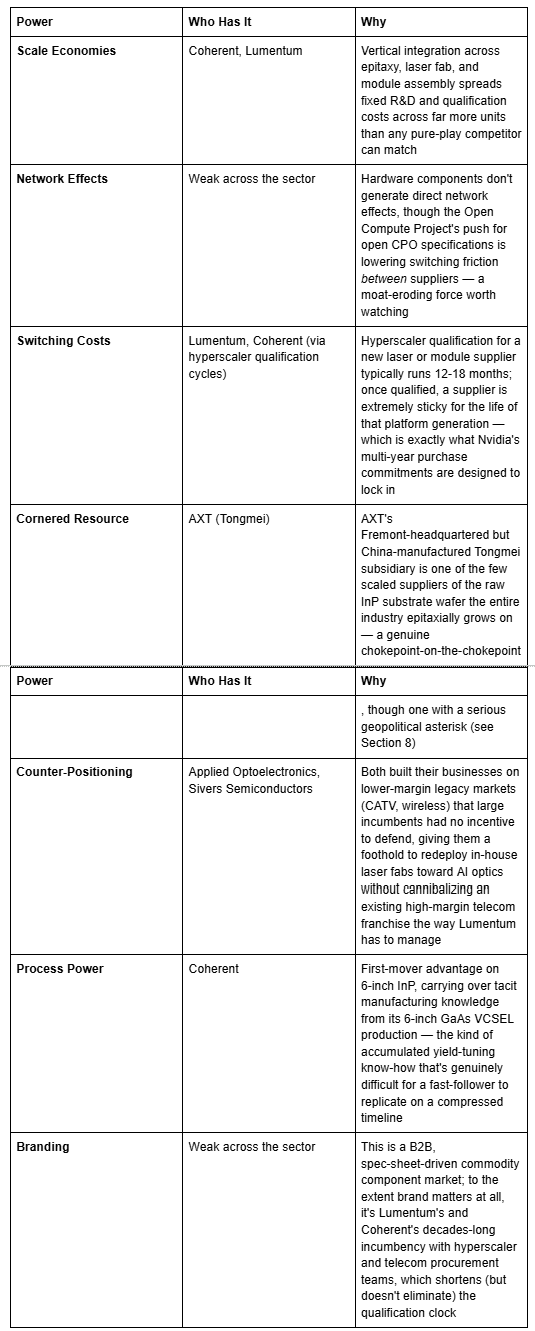
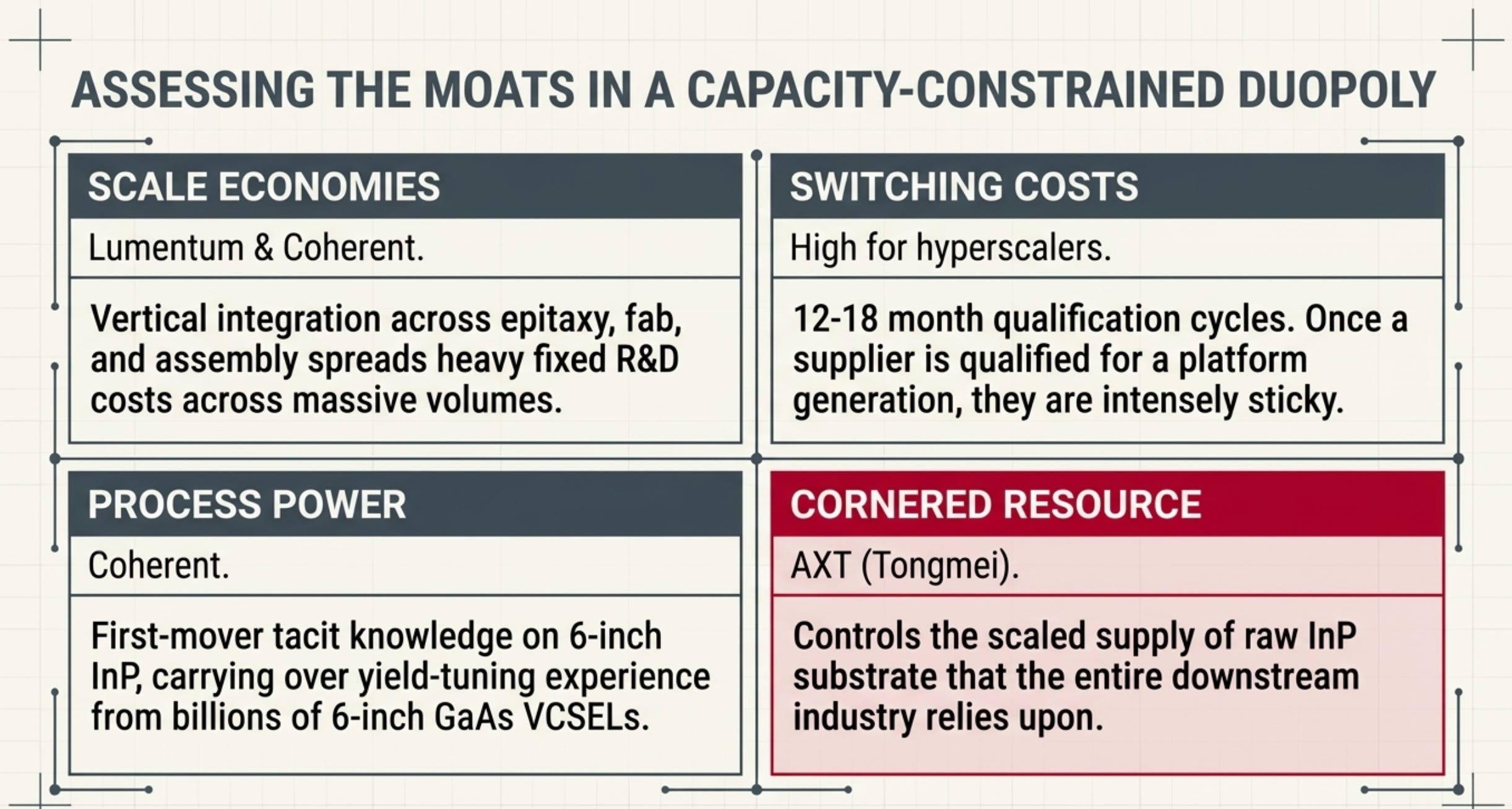
The honest read is that this isn’t a sector full of textbook moats — it’s a sector where the strongest power in play right now is a temporary one: scarcity itself, reinforced by switching costs that only bite once a customer has actually completed qualification. The Cornered Resource row is the most interesting because it’s also the most exposed, which is the whole tension this piece keeps circling back to.
7. The Fallback Scenario
If the InP bottleneck doesn’t clear on the optimistic 2026 timeline, the AI buildout doesn’t stop — it just gets more expensive and less efficient in a specific, predictable way. The GPUs that hyperscalers have already paid for and installed become network-starved: extremely expensive compute sitting at lower effective utilization because the fabric connecting thousands of GPUs into a single training cluster can’t be built out fast enough to match the compute side of the buildout. That’s a direct echo of the HBM and CoWoS packaging bottleneck that constrained GPU shipments in 2023 and 2024 — except this time the constraint has moved one layer downstream, from the chip itself to the wiring between chips.
A few second-order effects would likely follow. Capacity rationing intensifies, and strategic supply agreements — the Nvidia-backed names, the companies with signed long-term capacity reservations like AXT’s Lumentum deal — become the only reliable source of allocation, squeezing smaller or newer AI infrastructure players out of the queue entirely. Expect renewed urgency behind laser-count-reducing architectures: linear pluggable optics (LPO) and linear-drive designs that strip out a DSP stage to cut power and — less discussed — reduce the number of discrete laser components needed per unit of bandwidth; a harder push toward maximum-reach copper (DAC) cabling anywhere it can substitute for optics at all; and quite possibly a premature, reliability-risk-tolerant rush into co-packaged optics, because CPO architectures can reduce the total external light source count needed per unit of switch bandwidth even though they don’t eliminate the need for high-quality InP lasers altogether.
The geopolitical fallback is worth naming too: if the shortage persists, expect more of what’s already happening with AAOI’s Texas Semiconductor Innovation Fund grant — state and federal money flowing into domestic laser and substrate capacity, with InP increasingly discussed in the same breath as rare earths or advanced packaging: a critical input too important to source primarily from geopolitical rivals. That’s a tailwind for the Western pure-plays regardless of how the FCC rulemaking specifically shakes out.
8. Risks to the Thesis
Timeline slippage works both ways. LightCounting’s own base case has the shortage meaningfully easing by the end of 2026, and Coherent is running ahead of its 6-inch ramp schedule. If yields keep beating expectations across Lumentum, Coherent, and AXT simultaneously, the scarcity-pricing dynamic that’s currently supporting margins and valuations could compress faster than the market expects — the same dynamic now being debated in memory, where skeptics openly question whether the “shortage” narrative survives contact with 2027 supply. A component that goes from acutely scarce to merely tight in twelve months is a very different investment than one that’s structurally constrained for five years.
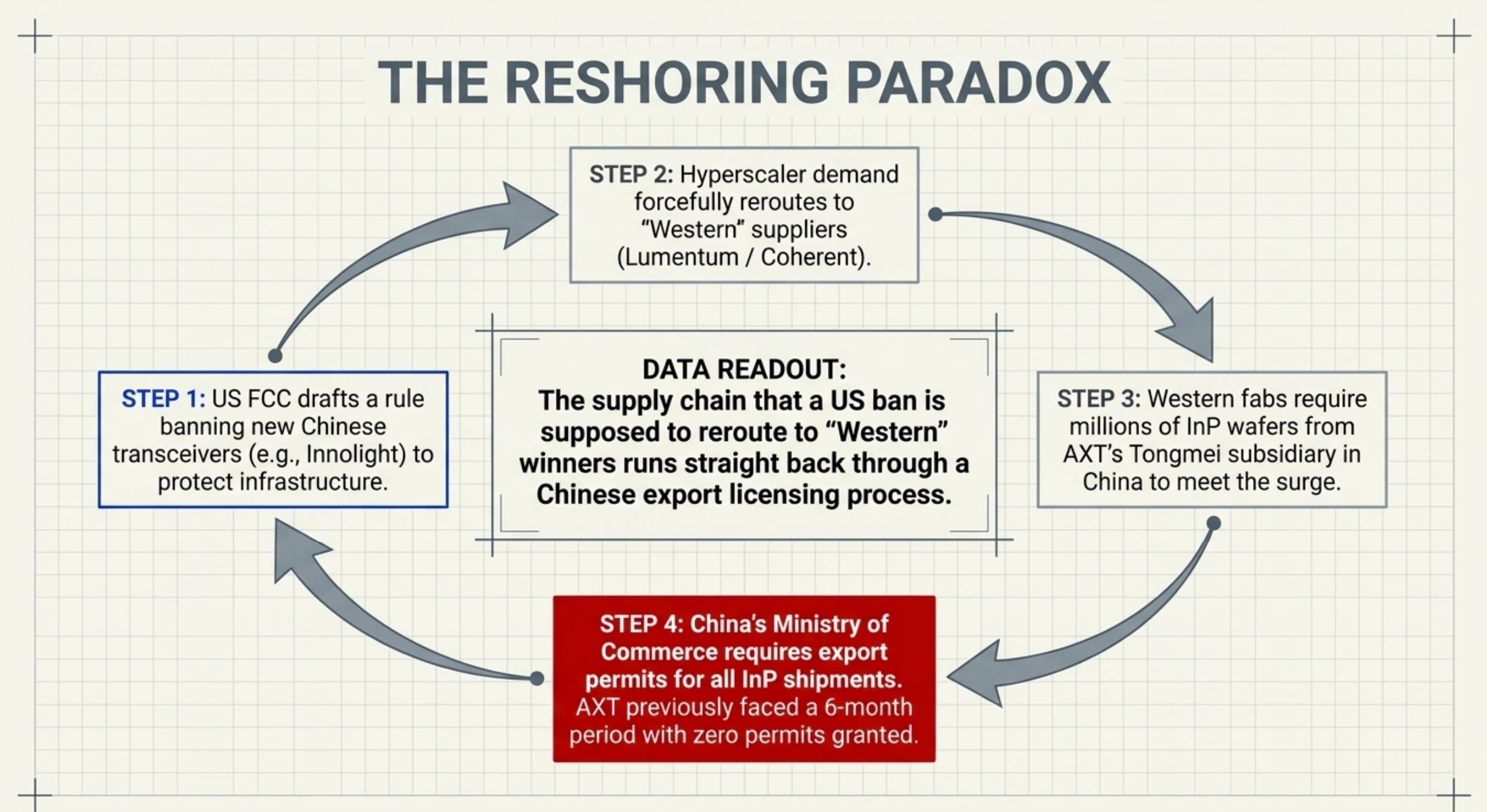
The cornered resource has a crack in it. This is the risk that deserves the most attention, because it’s the one nobody discussing “Western reshoring” seems to want to say out loud: AXT, the InP substrate supplier that just signed a multi-year capacity reservation with Lumentum, manufactures through its Tongmei subsidiary — based in China. Indium phosphide was added to China’s own export control list on February 4th, 2025, meaning AXT must secure a Chinese government export permit for every substrate order that leaves the country. The company has already disclosed a stretch where it received no export permits for a full half-year period. In other words: the supply chain that a US-China transceiver ban is supposed to reroute toward “Western” winners runs, at the substrate level, straight back through a Chinese export licensing process. That’s not a hypothetical tail risk — it already happened once, in 2025.
Regulatory follow-through is uncertain. Reuters’ sourcing was explicit that the FCC could still modify or shelve the transceiver restriction, and the agency’s own plan — as described by three of Reuters’ sources — is to ban new Chinese transceiver models while simultaneously exempting many non-Chinese suppliers from the broader restriction, which is a narrower and messier outcome than a clean market-share transfer. China’s embassy has already pushed back publicly, and Beijing has signaled it will respond to any action it views as materially harmful — a dynamic that, given InP’s own presence on China’s export control list, gives China a genuinely symmetrical retaliation option, not just a rhetorical one.
Valuations have moved a long way, fast. Coherent is up roughly 214% over the trailing 52 weeks and briefly touched an all-time high above $440 in early June before pulling back; Applied Optoelectronics is up well over 200% year-to-date; Lumentum, per GuruFocus’s model, was recently trading at more than a 600% premium to its estimated intrinsic value. None of that makes the thesis wrong, but it does mean a large share of the “scarcity is structural” narrative is already reflected in these prices — the incremental catalyst has to keep surprising to the upside just to hold current multiples, let alone re-rate higher.
Competitive dynamics could compress the window. Chinese domestic InP and laser investment doesn’t stand still just because Washington drafts a rule — and separately, if silicon-photonics-native architectures from GlobalFoundries, POET, and others succeed in reducing the number of discrete InP lasers required per unit of switch bandwidth, that’s structurally deflationary for laser suppliers even in a world of exploding total bandwidth demand, because the unit economics shift toward whoever owns the integration, not necessarily whoever owns the laser.
9. Conclusion — Who Owns the Chokepoint
Strip away the ticker noise and the ownership map is fairly clean. Lumentum and Coherent are the duopoly Nvidia has explicitly bet $4 billion on, and they’re the names that benefit most directly if the FCC ban proceeds roughly as drafted. Applied Optoelectronics is the higher-beta way to play the same trade — smaller, US-fabbed, capacity-constrained, and trading at a valuation that already assumes a lot goes right on schedule. Sivers Semiconductors is the true optionality name: a European micro-cap with real partnership traction (Jabil, POET, GlobalFoundries) but revenue still small enough that the stock trades more on news flow than fundamentals — a legitimate way to get exposure to the theme, provided you size it like the volatile small-cap it is.
But the name that best captures the whole thesis in one company is AXT. It’s the most literal chokepoint owner in the entire value chain — the substrate everyone else epitaxially grows their lasers on — and simultaneously the clearest illustration of why “the West is de-risking its optical supply chain from China” is a more complicated sentence than the headlines suggest. The reshoring trade and the China-dependency trade are, at the substrate level, the same trade wearing different names.
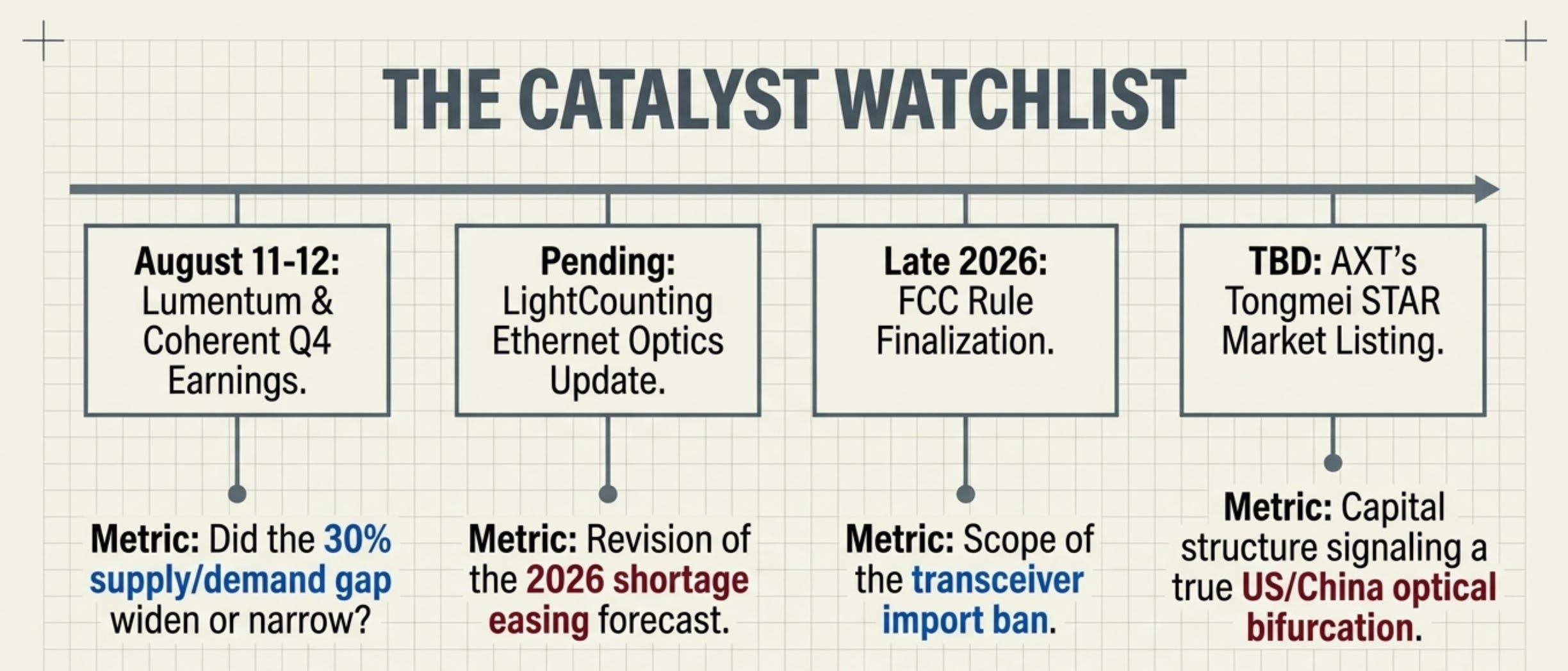
What to watch: Lumentum’s fiscal Q4 print on August 11th and Coherent’s on August 12th, both of which will show whether the 30%+ supply gap narrowed or widened again; the FCC’s rulemaking timeline on the transceiver ban, which officials reportedly hope to finalize and publish before year-end; LightCounting’s next quarterly Ethernet optics update, which will be the best independent read on whether the shortage is actually on pace to ease by late 2026 as currently forecast; and AXT’s progress toward listing its Tongmei subsidiary on Shanghai’s STAR Market — a corporate action that would tell you a lot about how AXT itself is positioning for a world where Chinese and Western optical supply chains genuinely bifurcate.
Disclaimer:
This is not financial or investment advice. This piece is for informational and educational purposes only, reflects publicly available information as of early August 2026, and should not be relied upon as the basis for any investment decision. Markets, especially in richly valued, high-beta small- and mid-cap names, can move sharply and unpredictably. Do your own research, consult a licensed financial advisor, and never invest more than you can afford to lose.